Procedural Justice 3 Community Training Deck (Template)

The goal of this course is to engage police officers and the communities they serve in critical thought and discussion about contemporary mechanisms of bias regarding race, gender, sexuality, and other identities within the context of law enforcement centering on identity traps and drawing on the scholarship of implicit bias and self-threats.​ Click here to view and download the PowerPoint.


Procedural Justice 3 Training Deck (Template)

The goal of this course is to engage police officers and the communities they serve in critical thought and discussion about contemporary mechanisms of bias regarding race, gender, sexuality, and other identities within the context of law enforcement centering on identity traps and drawing on the scholarship of implicit bias and self-threats. Click here to view and download the PowerPoint.


Procedural Justice 2 Training Deck (Template)

The goal of this course is to reintroduce the principles of procedural justice, gain a deeper understanding of the core concepts of police legitimacy, and build better relationships within the communities that we serve via the use of visual and scenario-based training. Click here to view and download the PowerPoint.


Procedural Justice 1 Training Deck (Template)

The goal of this course is for law enforcement officers to understand and employ the core concepts of police legitimacy and procedural justice in order to build better relationships with the communities they serve. Click here to view and download the PowerPoint.


Enhancing Police Responses to Children Exposed to Violence: A Toolkit for Law Enforcement

The International Association of Chiefs of Police (The IACP) and the Yale Child Study Center (Yale), with support from the Office of Juvenile Justice and Delinquency Prevention (OJJDP), Office of Justice Programs, U.S. Department of Justice, has launched the Enhancing Police Responses to Children Exposed to Violence: A Toolkit for Law Enforcement. This new toolkit provides practical tools and resources to assist law enforcement agencies in building or enhancing effective operational responses to children exposed to violence (with or without a mental health partner). This toolkit contains tools targeted to police leaders and frontline officers.


IACP Communities of Color Toolkit

"The International Association of Chiefs of Police (IACP) convened three focus groups of community stakeholders, frontline officers, and law enforcement executives to discuss building community trust. They discussed  strategies that have been used successfully to develop communities of trust and identified challenges facing law enforcement and the community.  This toolkit collects some of the most successful strategies, and tools for engaging communities of color, here defined as people of African, Latino or Hispanic, Native American, Asian, or Pacific Island descent. 

Communities of color have faced many decades of real and perceived mistreatment by the justice system and law enforcement, leading to fear, anger, resentment, and distrust. Communities of color often feel marginalized and mistreated. Recognizing and responding to mistrust lies at the heart of building stronger community-police relationships.  This requires a variety of resources, protocols, policies, strategies, and training. Communities of color and police must continue to join forces to create safe environments. In this toolkit we share a number of promising programs working to improve community-police relations on a daily basis."


Executive Summary

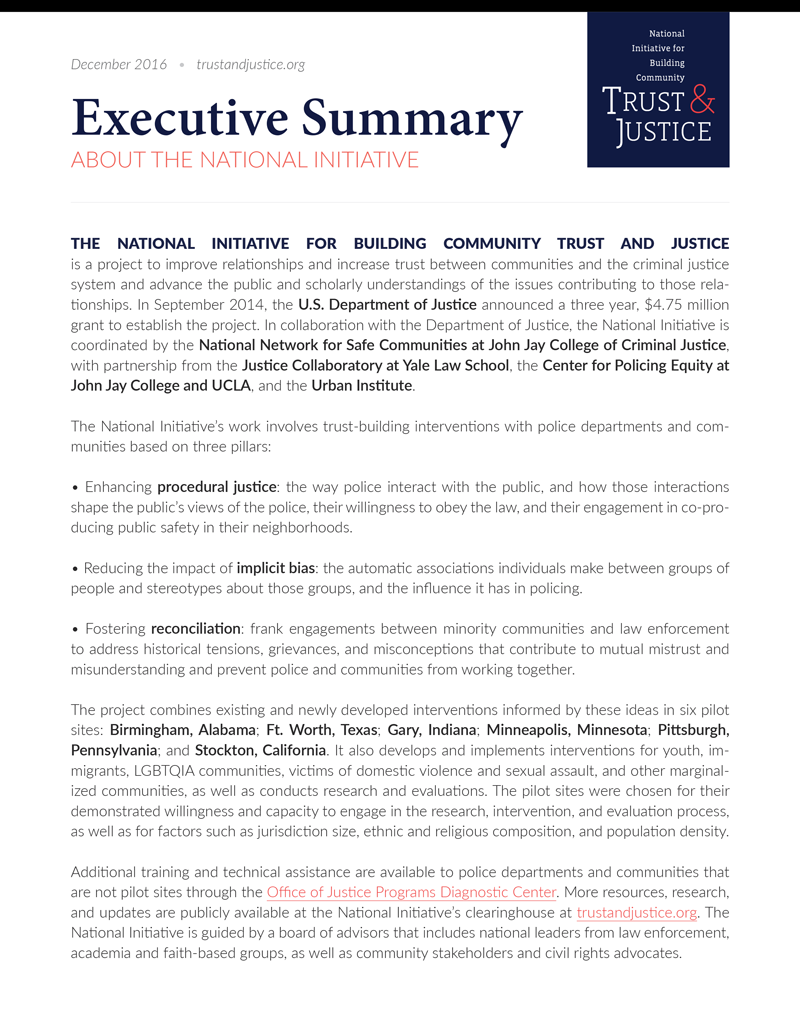
The National Initiative for Building Community Trust and Justice is a project to improve relationships and increase trust between communities and the criminal justice system and advance the public and scholarly understandings of the issues contributing to those relationships. In September 2014, the U.S. Department of Justice announced a three year, $4.75 million grant to establish the project. In collaboration with the Department of Justice, the National Initiative is coordinated by the National Network for Safe Communities at John Jay College of Criminal Justice, with partnership from the Justice Collaboratory at Yale Law School, the Center for Policing Equity at John Jay College and UCL​A, and the Urban Institute.


Leveraging Community Voices in Violence Prevention

On September 27, 2016, research conducted by the Urban Institute under the National Initiative was presented by Nancy La Vigne at a Congressional Briefing on "Violence and Violence Prevention." At the briefing, which was sponsored by Center for Evidence-Based Crime Policy (CEBCP) in collaboration with WestEd’s Justice and Prevention Research Center, La Vigne detailed data collected from surveys distributed to residents of high-crime, low-income neighborhoods in each of the National Initiative’s six pilot sites—Birmingham AL; Fort Worth, TX; Gary, IN; Minneapolis, MN; Pittsburgh, PA; and Stockton, CA—that confirms suspicions of longstanding mistrust between law enforcement and communities of color.

For example, fewer than half of all survey respondents believe that police officers are responsive to community concerns and are held accountable for misconduct. Similarly, more than half of those surveyed agreed that officers judge local residents "based on personal biases or prejudices" and that they treat people differently based on their race or ethnicity.

Despite this high degree of mistrust, law enforcement and communities of color share common ground, with many residents willing to serve as active partners in crime prevention. More than 60 percent of respondents said they would report crimes or suspicious activities to police and about half said they would attend community meetings to discuss crime prevention. 

These surveys, part of the National Initiative's research and evaluation component, were distributed in each of our six pilot sites before the project was underway. Following its completion, a second round of surveys will be distributed to measure the impact of interventions oriented around implicit bias, procedural justice, and reconciliation.

Click here to download a PDF of the presentation and below for the video.


Law Enforcement and the Transgender Community: A Training Video

The U.S. Department of Justice's Community Relations Service (CRS), aiming to improve interactions between police and transgender individuals, has soft-launched a new cultural professionalism roll-call training video entitled “Law Enforcement and the Transgender Community.” The video, which features scenarios of the three most common ways police officers encounter members of the transgender community, provides the information, tools, and techniques for departments to exercise procedural justice and mitigate implicit bias when interacting with this community.


Webinar: The Importance of Enhancing Procedural Justice in Interactions with Juveniles

This webinar describes recent research demonstrating the particular salience of procedural justice to juveniles, a group that has frequent contact with the criminal justice system and whose orientation toward the law is still being established. Presenters discussed how criminal justice actors can use the insights of this research to improve their legitimacy in the eyes of young people in their communities.

Click here to view the webinar and download the webinar handouts: https://ojjdptta.adobeconnect.com/_a1110525827/p2nf6cnuvd0/?launcher=false&fcsContent=true&pbMode=normal


Street Stops and Police Legitimacy in New York

Police-initiated citizen encounters in American cities often are non-neutral events. As a crime detection and control strategy central to the “new policing,” these encounters often are unproductive and inefficient. They rarely result in arrest or seizure of contraband, and often provoke ill will between citizens and legal authorities that discourages citizen cooperation with police and compliance with law. In Street Stops and Police Legitimacy in New York, Tracey L. Meares and Tom Tyler from the Justice Collabatory at Yale Law School and Jeffrey Fagan from Columbia Law School describe the range of potentially adverse reactions or harms that SQF or ‘street’ policing may produce; link those harms to a broader set of concerns that connect dignity, harm and police legitimacy; and review the evidence that connects citizen views of police – as well as their experience with police – to their perceptions of the legitimacy of the police and criminal legal institutions generally.


Webinar: Fostering Processes of Reconciliation

This webinar describes the National Initiative's implementation efforts in its six pilot sites and gives background on the concepts and practices of reconciliation. In many communities where public trust in law enforcement has been compromised, a deliberate process of reconciliation is necessary before law enforcement and communities can work together to improve public safety. The presenter, David Kennedy, described the developing practices associated with reconciliation, how they can improve public trust and collaboration with law enforcement, and how this will be carried out in the National Initiative's six pilot sites.  

Click here to view the full webinar: https://ojjdptta.adobeconnect.com/_a1110525827/p6pteavmg2a/?launcher=false&fcsContent=true&pbMode=normal


Reducing the gap in perceptions of legitimacy of victims and non-victims

Crime victims are a unique subgroup who evaluate the police and police legitimacy more harshly than those who have not been victimized. This could be explained by their victimization, and their special needs from and expectations of the police. Reducing the gap in perceptions of legitimacy of victims and non-victims finds that procedural justice operates similarly for victims and non-victims, but that police performance plays a much more important role as an antecedent for victims.


System contact and procedural justice policing: Improving quality of life outcomes for victims of crime

Victims of crime often feel re-victimised when they come into contact with criminal justice professionals. Police, as first responders to many victimisation experiences, therefore need to be particularly sensitive to the way in which they treat victims if they wish to reduce the occurrence of such secondary victimisation. System contact and procedural justice policing seeks to explore the role that procedural justice policing can play in improving the wellbeing and quality of life of crime victims after system contact. 


Procedural Injustice, Risky Lifestyles, and Violent Victimization

Participation in risky lifestyles is a well-established predictor of victimization. Several variables have been identified as key predictors of risky activities (e.g., low self-control) but there may be additional sources not considered in the literature to date. Procedural Injustice, Risky Lifestyles, and Violent Victimization argues that perceptions of procedural unfairness represent a break in social control, thereby opening the door for participation in risky lifestyles that are conducive to victimization. The study demonstrates that police procedural injustice was positively associated with risky lifestyles, which partially mediated the relationship between procedural injustice and violent victimization.


Racial Disparities in Youth Commitments and Arrests

While youth incarceration has declined sharply over the last decade, racial disparities have actually increased. A report by The Sentencing Project reviews the nationwide and state-by-state status of racial and ethnic disparities in commitments and the likely impact of growing racial disparities in arrests.


Citation in Lieu of Arrest

Citation in lieu of arrest potentially offers numerous benefits for law enforcement, the criminal justice system, and those cited. Yet the impact of the practice has not been significantly studied. A report from the International Association of Chiefs of Police (IACP) provides a three-pronged assessment of citation in lieu of arrest, a new baseline of information, and a path forward for effective policies for the criminal justice system, officers, and citizens.


meetLEO

There are over 780,000 law enforcement officers nationwide. meetLEO, and the Friends with LEO curriculum, is targeted at 6th grade students and intended to be taught in the classroom by an LEO. The curriculum covers stereotypes, racism, and ethical decision making through a variety of interactive lessons to enhance student relationships with their local law enforcement.  

For more information, contact Lucia Turck at lucia.turck@usdoj.gov.


Ethnic Identity, Procedural Justice, and Offending: Does Procedural Justice Work the Same for Everyone?

Ethnic Identity, Procedural Justice, and Offending examines the interaction between procedural justice and ethnic identity on two measures of offending, self-report and number of arrests, in a longitudinal study of serious juvenile delinquents.


Arrestees Perceptions of the Police: Exploring Procedural Justice, Legitimacy, and Willingness to Cooperate With Police Across Offender Types

Arrestees’ Perceptions of the Police: Exploring Procedural Justice, Legitimacy, and Willingness to Cooperate With Police Across Offender Types explores the relationship between procedural justice, police legitimacy, and willingness to cooperate with police among adults who have recently been arrested. Findings indicate that procedural justice is strongly associated with views of police legitimacy, and perceptions of police legitimacy do not vary by offender type. Procedural justice and legitimacy perceptions are powerful predictors of willingness to cooperate with the police.


NNSC National Conference 2015: Applying Procedural Justice and Police Legitimacy

This panel from the National Network for Safe Communities' conference discusses the ways law enforcement entities around the country have begun to integrate the principles of community trust, procedural justice, and legitimacy into recruit and in-service training and practice with the aim of improving relationships between law enforcement and the communities it serves. Panelists address how to introduce these concepts into law enforcement organizations, build buy-in, and sustain the practices. Moderated by Megan Quattlebaum, Program Director for the Yale Justice Collaboratory, this panel features Tom Tyler, Macklin Fleming Professor of Law at Yale University; Greg Berman, Executive Director of the Center for Court Innovation; Bruce Lipman, Lieutenant (ret.) at the Chicago Police Department; Ronal Serpas, Superintendent (ret.) of the New Orleans Police Department​;  and Daniela Gilbert, Deputy Director of the California Partnership for Safe Communities.


NNSC National Conference 2015: Karol V. Mason

Karol V. Mason, Assistant Attorney General for the Office of Justice Programs, delivers the keynote address of the National Network for Safe Communities' National Conference 2015.


NNSC National Conference 2015: Truth-Telling, Reconciliation, and the National Initiative

This plenary session of the National Network for Safe Communities' conference provides an overview of the National Initiative for Building Community Trust and Justice and situates it within the context of the post-Ferguson climate around trust, legitimacy, reform, and reconciliation. Participants discuss the genesis of the National Initiative, its aims and early steps, and its relevance to the national interest in re-examining traditional criminal justice and promoting truth-telling and reconciliation between law enforcement and the communities it serves. Moderated by David Kennedy, Director of the NNSC, this panel features Katherine Darke Schmitt, Policy Advisor in the Office of Justice Programs at the US Department of Justice, Tom Tyler, Macklin Fleming Professor of Law at Yale University, Tracie Keesee, Project Director of the National Initiative for Building Community Trust and Justice, and Priscilla Hayner, independent writer and consultant on truth and reconciliation processes.


NNSC National Conference 2015: Police and Communities in Motion

This plenary session of the National Network for Safe Communities' conference addresses the cultural shifts taking place in law enforcement agencies and communities around the country. Participants discuss how gradually changing law enforcement practices have affected the relationships between police and the communities they serve, and how momentum has built behind practices that acknowledge history, repair legitimacy, and rebuild public trust. Moderated by Professor Phillip Atiba Goff of the Center for Policing Equity at UCLA, this panel features Chief A.C. Roper of Birmingham Police Dept., Ben McBride, Founder of the Empower Initiative, and Rev. K. Edward Copeland, Pastor of the New Zion Baptist Church of Rockford, IL.


Enhancing Law Enforcement Response to Victims | A Joint Effort of the Office of Victims of Crime (OVC) and the International Association of Chiefs of Police

IACP’s Enhancing Law Enforcement Response to Victims (ELERV) includes the following resources:

  • 21st Century Strategy
  • Implementation Guide
  • Resource Toolkit
  • Training Supplement  


Interim Report of the President’s Task Force on 21st Century Policing

“When any part of the American family does not feel like it is being treated fairly, that’s a problem for all of us,” said the President. “It’s not just a problem for some. It’s not just a problem for a particular community or a particular demographic. It means that we are not as strong as a country as we can be. And when applied to the criminal justice system, it means we’re not as effective in fighting crime as we could be.”

Download and read the full report.


Tracey Meares: The Legitimacy of Police Among Young African-American Men

In this video of the Inaugural George and Margaret Barrock Lecture, Professor Tracey Meares of Yale Law School speaks at Marquette Law School on police legitimacy among African-American men.


Tracey Meares: Understanding Deterrence and Legitimacy in Law

In this series of short videos, Professor Tracey Meares of Yale Law School discusses the theories of deterrence and legitimacy of law that underpin Project Safe Neighborhoods.


Dating Violence Experiences of Lesbian, Gay, Bisexual, and Transgender Youth

Media attention and the literature on lesbian, gay, and bisexual youth overwhelmingly focus on violence involving hate crimes and bullying, while ignoring the fact that vulnerable youth also may be at increased risk of violence in their dating relationships. A study from the Urban Institute examines physical, psychological, sexual, and cyber dating violence experiences among lesbian, gay, and bisexual youth-as compared to those of heterosexual youth, and explores variations in the likelihood of help-seeking behavior and the presence of particular risk factors among both types of dating violence victims.


Leadership


Subscribe to the National Initiative mailing list